
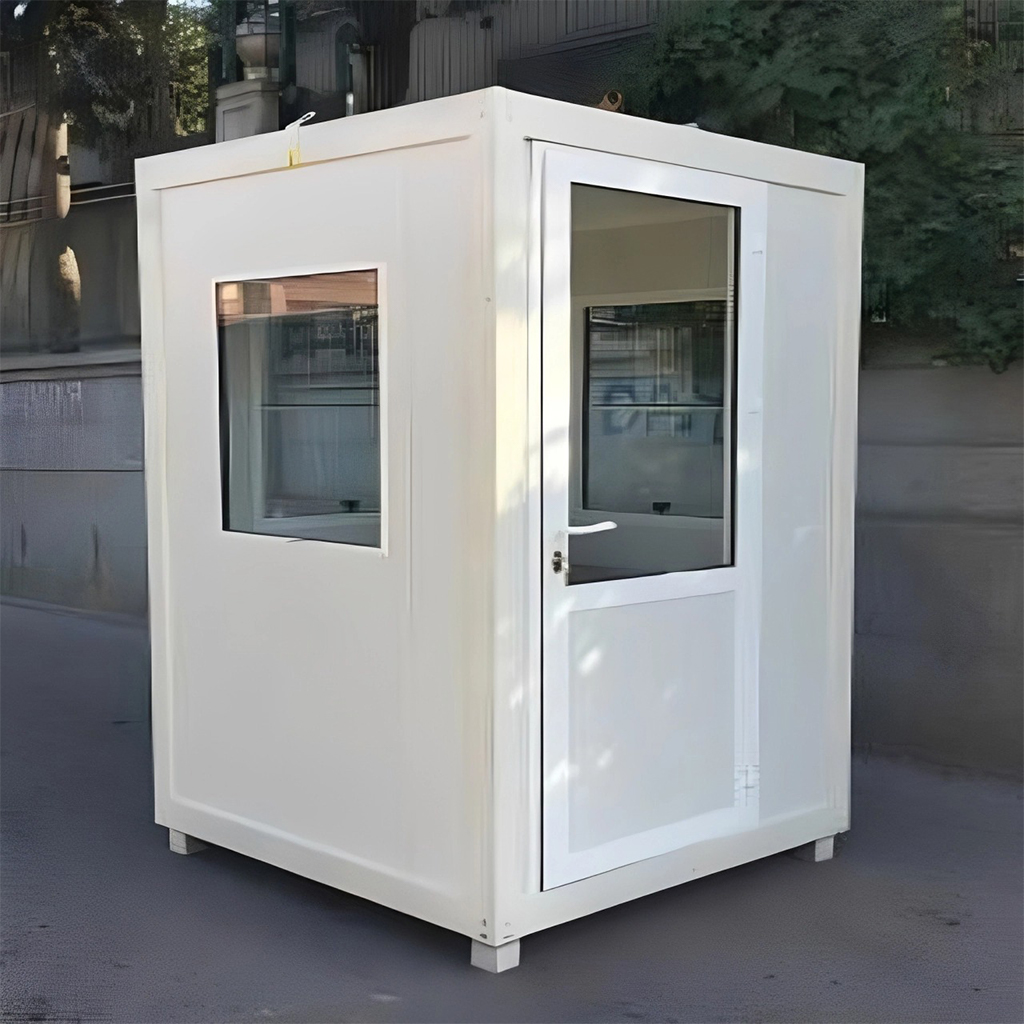
Across the UAE, the pace of development has not slowed. Construction corridors stretch from Ruwais to Ras Al Khaimah. Logistics parks, data centres, and mixed-use megaprojects are in various stages of planning or execution. With all of this activity comes a straightforward but pressing challenge — how do you secure a site that keeps changing shape?
Traditional guard rooms and brick-and-mortar security posts made sense in a different era of construction. Today, they create delays, drive up costs, and offer almost no flexibility when project boundaries shift. Modular security cabins have emerged as a practical response to this problem — not as a compromise, but as a genuine upgrade.
This guide breaks down what makes these units effective, what to look for when specifying them, and how to choose a supplier who will deliver on the promise.
What Modular Security Cabins Actually Are
A modular security cabin is a factory-built, prefabricated structure designed for on-site security operations — monitoring, access control, personnel management, and increasingly, integration with digital surveillance systems. Units arrive on-site ready for immediate use, requiring no concrete pours and minimal groundwork.
The distinction from traditional portable cabins is worth making clear. Older-generation site cabins were essentially steel boxes with a power connection. Modern modular security cabins are engineered units with defined thermal performance, structural ratings, technology provisions, and in many cases, compliance documentation for UAE regulatory frameworks. The difference in operational outcome is significant.
Key characteristics include factory-manufactured and delivered installation-ready units, suitability for temporary deployment or permanent placement, the ability to be relocated across multiple project sites, and availability in both standard formats and fully customised configurations.
Designing for UAE Climate Conditions
Thermal performance is not a secondary consideration in the Gulf. Ground temperatures on unshaded surfaces regularly exceed 55°C in peak summer. A cabin that does not manage heat effectively is not just uncomfortable — it creates operational problems. Security personnel who are overheated become less alert. Equipment in poorly insulated enclosures degrades faster. Air conditioning systems working against inadequate insulation consume excessive power.
Properly specified security cabins address this through a combination of high-density PUF (Polyurethane Foam) insulation, ACP (Aluminium Composite Panel) sandwich panels, and heat-resistant exterior coatings. The measurable result is a 30–50% reduction in air conditioning energy consumption compared with uninsulated alternatives — a figure that adds up quickly over a multi-year project.
Beyond energy savings, well-insulated cabins maintain a consistently stable interior environment regardless of external conditions. For security operations that run around the clock, this matters considerably.
Fast Deployment When Timelines Are Tight
Construction and infrastructure projects in the UAE often move at a pace that makes traditional building methods impractical. A security point that takes three weeks to build is a liability when the access gate needs to be operational in 48 hours.
Modular security cabins can be transported by truck or crane, positioned, connected to utilities, and made operational within 24 to 48 hours of arrival. No permanent foundations are required. Site preparation is minimal. When the project phase ends or boundaries shift — as they frequently do in large-scale developments — the unit can be relocated rather than abandoned.
This reusability changes how organisations account for the cost. Rather than a write-off at the end of a project, a well-specified modular cabin becomes a movable asset that can be deployed across multiple sites over several years.
Technology Integration: Beyond the Basic Guard Post
The role of a security cabin has changed considerably. Physical presence at an access point is only one component of what a modern security operation requires. Today, cabins are expected to function as control nodes — managing CCTV feeds, handling biometric access data, processing RFID vehicle tracking, and feeding into IoT-enabled monitoring platforms.
Quality modular security cabins are pre-wired and structured to accommodate these systems from the outset. Cable management, power provision, network connectivity points, and equipment mounting positions are built into the unit during manufacturing — not added as afterthoughts on site.
Centralised monitoring of multiple locations, faster incident response, and reduced manual dependency are the practical outcomes. What was once a single-function guard room now operates as a functional security command point.
Regulatory Compliance and Safety Standards in the UAE
For any structure deployed on a UAE project site, compliance with local civil defence regulations and structural safety standards is non-negotiable. This applies equally to modular units. Reputable manufacturers design their cabins to meet UAE Civil Defence requirements and recognised fire-rated standards, including A-30, A-60, and A-120 ratings, depending on the application.
For high-security environments — oil and gas facilities, airport perimeters, embassy compounds, data centres — ballistic protection options are also available. Cabins built to BR4 through BR10 standards offer reinforced steel construction and specialised safety systems appropriate for critical asset protection.
When selecting a supplier, verifying that compliance documentation exists and is current is an important step — not simply taking it as given.
Types of Security Cabins: Matching the Unit to the Application
One of the more useful aspects of the modular security cabin market is the range of available configurations. There is no requirement to over-specify or under-specify.
Standard Portable Cabins are cost-effective units suited to construction sites, temporary access points, and parking areas. Basic electrical provision, straightforward to deploy and relocate.
Executive or Luxury Cabins are designed for residential communities, corporate campuses, and any setting where the security point is visible and needs to reflect the quality of the surrounding environment. Enhanced interior finishes and exterior aesthetics without compromising operational function.
Self-Contained Cabins are standalone units that come with built-in toilet and washing facilities, making them ideal for remote locations, extended operations, or sites where worker welfare needs to be prioritised.
High-Security and Bullet-Resistant Cabins are purpose-built for critical infrastructure and sensitive sites. Ballistic-rated construction, reinforced steel framing, and compatibility with advanced protection systems.
Sustainability and Energy Efficiency
Sustainability has moved from an optional consideration to a procurement requirement across many UAE public and private sector projects. Modular security cabins contribute positively here in several ways. Off-site manufacturing significantly reduces on-site construction waste. Insulation systems lower ongoing energy consumption. Solar panel integration is increasingly available, making off-grid or reduced-grid operation viable for remote locations.
For projects working toward green building certifications or operating under sustainability mandates, these characteristics are worth specifying explicitly in procurement documents.
Cost Efficiency and Return on Investment
The financial case for modular security cabins is reasonably straightforward. Initial investment is lower than equivalent permanent construction. Installation costs are minimal. Maintenance requirements are predictable and generally modest.
The more significant advantage is reusability. An organisation running multiple projects simultaneously or sequentially can treat modular security cabins as long-term assets rather than project-specific costs. The same unit that secures a construction site during the build phase can be relocated to a new project the following year. Over a five to ten-year horizon, the return on investment typically exceeds what static alternatives can deliver.
How to Choose the Right Security Cabin
Selecting the appropriate unit involves working through several practical questions. Where will the cabin be deployed, and for how long? Construction sites, residential communities, industrial zones, and high-security environments each carry different requirements. What level of technology integration is needed now, and what might be required in six or twelve months? Pre-wired cabins avoid retrofit costs down the line. How many personnel will occupy the unit, and what equipment needs to be housed inside? Will the unit need to be relocated, and how frequently — because this affects foundation type and transport considerations. Are there specific fire, safety, or ballistic compliance requirements tied to the site or client contract?
Answering these questions before approaching a supplier leads to a much cleaner specification and avoids the common outcome of paying for features that were never needed, or discovering mid-project that critical provisions were missed.
Choosing the Right Supplier in the UAE
The cabin itself is only part of the equation. A supplier who understands the UAE operating environment, delivers on time, and provides support after installation makes a material difference to project outcomes.
Experience in the UAE market matters in ways that are not always obvious. Local knowledge of climate conditions, logistics constraints, and regulatory requirements is genuinely valuable — not just a marketing point on a company profile.
Certifications such as ISO 9001:2015 (Quality Management), ISO 14001:2015 (Environmental Management), and ISO 45001:2018 (Occupational Health and Safety) indicate structured, consistent manufacturing processes. These are not credentials to list on a brochure — they reflect real differences in production quality and material traceability.
Customisation capability is worth probing specifically. Standard dimensions and layouts rarely fit every project requirement. A supplier with genuine design flexibility saves time and cost over the life of the project.
Material quality should be verified, not assumed. High-grade PUF insulation and ACP panels are the baseline. Asking for material specifications and, where relevant, test certificates is a reasonable request that credible suppliers will handle without difficulty.
After-sales support matters significantly for long-duration deployments. Maintenance responsiveness, spare parts availability, and accessible technical support are things to establish before the contract is signed.
Delivery and installation track record is best assessed through references from comparable UAE projects. On-time delivery and proper installation are not assumptions to make — they are things to verify.
Conclusion
Security requirements in the UAE have become more complex, not less. Large-scale development, expanding industrial activity, and the integration of digital surveillance into everyday site management have all raised the bar for what a security point needs to deliver.
Modular security cabins have evolved to meet this — combining thermal resilience, fast deployment, technology readiness, and regulatory compliance in units that can be moved, reused, and adapted as project needs change. For organisations managing multiple sites or long-duration projects across the UAE, they represent both a practical solution and a sound investment.
The key is specifying the right unit for the right environment, and working with a supplier who has demonstrated they can deliver under real site conditions — not just on paper.
