

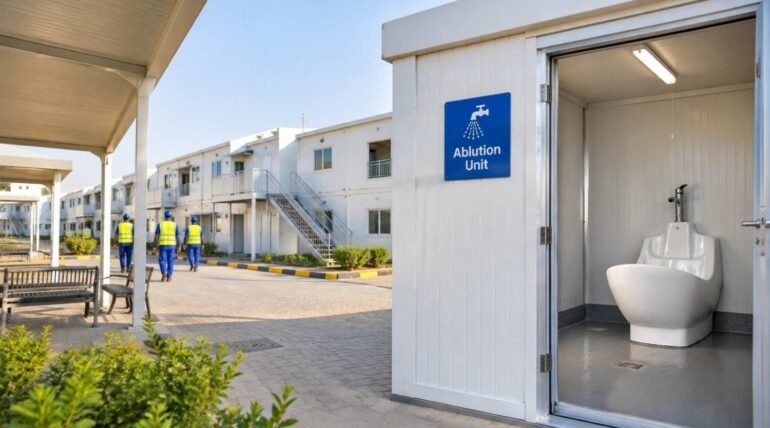
Labour camps and workforce accommodation facilities in the UAE need well-planned sanitation and washing areas that support workers’ daily routines, hygiene and comfort. For Muslim workers, dedicated ablution facilities provide a practical space to perform wudu before daily prayers. Their design requires careful consideration of water supply, drainage, privacy, user capacity and ease of maintenance.
Custom Prefabricated Ablution Units offer a flexible option for projects that need purpose-designed wudu facilities without relying entirely on conventional on-site construction. When planned around the number of users, site conditions and applicable local requirements, these units can help contractors and accommodation operators provide organised ablution spaces for both permanent and temporary facilities.
Why Ablution Facilities Matter in Workforce Accommodation
In busy labour camps, many residents may need to perform wudu around the same prayer times. If washing points are limited, poorly positioned or difficult to maintain, queues and congestion can quickly become a problem.
A dedicated ablution area helps separate wudu activities from general bathroom use and provides a space designed specifically for washing before prayer. This is particularly useful in large accommodation facilities, industrial projects, construction camps and remote work locations where access to suitable permanent facilities may be limited.
Planning should consider more than the number of washing points. Safe movement, convenient access from accommodation blocks, effective drainage and a straightforward cleaning routine all contribute to a facility that works well throughout the day. Labour camps may require separate facilities for different hygiene needs, including dedicated wudu areas and portable sanitation facilities for general restroom use.
Assess the Number of Users and Peak Demand
The first step is to estimate how many residents will use the ablution facility and when demand is likely to be highest. Total camp occupancy provides a starting point, but it does not automatically determine the required number of washing points.
Consider the following factors:
- Resident capacity: Estimate the number of workers who may use the facility regularly.
- Prayer-time demand: Account for periods when several residents need to perform wudu within a short time.
- Shift schedules: Workers arriving from or leaving industrial and construction shifts may create additional demand.
- Facility availability: Consider whether other suitable ablution areas are available nearby.
- Future expansion: Allow for possible increases in workforce numbers or changes to accommodation arrangements.
A simple demand assessment can help determine the number of washing positions, the space required and whether one larger unit or several smaller units would suit the site better.
Choose Custom Prefabricated Ablution Units That Suit the Site
Not every labour camp has the same layout, available space or infrastructure. Custom Prefabricated Ablution Units can be planned around these differences, allowing the layout and dimensions to reflect the project’s requirements.
Before selecting a unit, consider its intended location, expected usage, available water connections, drainage arrangements and access for cleaning and maintenance.
A smaller labour camp may need a compact ablution area near the accommodation blocks, whereas a larger camp may require several washing areas to serve workers staying in different sections.
Prefabrication can also help organise construction and installation work. Components can be prepared in advance, reducing the amount of on-site building work required. However, delivery access, foundation or support requirements, utility connections and local approvals still need to be addressed before installation.
Plan Water Supply and Drainage Carefully
Reliable water supply and effective wastewater drainage are essential to a functional wudu facility. Several washing points may operate simultaneously during busy periods, so the water system must be assessed for actual demand rather than average use alone.
When planning a prefabricated wudu facility, check:
- Whether the existing water supply can support simultaneous use.
- Whether pipe sizes and water pressure are appropriate for the proposed layout.
- Whether sufficient drainage capacity is available.
- How wastewater will connect to the approved sewerage or collection system.
- Whether pipes, taps, drains and other components can be accessed for repairs.
Floor drainage deserves particular attention. Poorly directed water can create standing puddles, unpleasant odours and slippery surfaces. A suitable floor gradient, correctly positioned drains and accessible traps help manage wastewater and make cleaning easier.
Where a site has limited utility infrastructure, the project team should establish an approved water-supply and wastewater-management strategy before choosing the final unit configuration.
Prioritise Hygiene, Safety and Practical Design
Ablution areas experience regular contact with water, frequent foot traffic and repeated cleaning. Materials and finishes should therefore be selected for durability, water resistance and ease of maintenance.
Slip-resistant flooring is particularly important because water may remain on the floor during busy periods. Taps, washing fixtures and other fittings should be robust enough for frequent use, while surfaces should allow cleaning teams to remove dirt and moisture effectively.
Good layout planning should also provide sufficient room for users to move between washing points without unnecessary obstruction. Where appropriate, seating or dedicated foot-washing arrangements can be incorporated according to the intended method of use and project specifications. Depending on the site’s requirements, separate hand wash stations may also help provide convenient access to handwashing facilities.
Ventilation is another consideration, especially in enclosed facilities exposed to the UAE’s hot and humid conditions. Suitable ventilation helps manage moisture and odours, while corrosion-resistant components can improve durability in demanding environments.
Consider the UAE Climate and Operating Conditions
The UAE’s climate makes material selection and ongoing maintenance especially important for outdoor and semi-outdoor ablution facilities. Heat, dust, humidity and exposure to the elements can affect fittings, seals, pipework and external surfaces.
When specifying prefabricated wudu facilities in the UAE, project teams should assess whether the proposed materials and equipment are suitable for the installation environment. Shading, weather protection, ventilation and access to serviceable components can all influence long-term performance.
Water efficiency is another practical consideration. Appropriately selected water-saving fixtures, prompt leak repairs and regular monitoring can help reduce unnecessary consumption. Any water-reuse arrangement must be properly designed and permitted for its intended use; wastewater should never be reused for ablution without an appropriate, approved treatment and supply arrangement.
Establish a Cleaning and Maintenance Routine
Even a well-designed unit needs consistent upkeep. In workforce accommodation, cleaning and maintenance arrangements should be established before the facility becomes operational.
A practical maintenance plan should include:
- Regular cleaning of washing points, floors and frequently touched surfaces.
- Inspection of taps, pipework and drainage traps for leaks or blockages.
- Prompt removal of standing water and attention to slippery areas.
- Restocking of any required cleaning or hygiene supplies.
- Scheduled inspection of ventilation equipment and other service components.
Assigning responsibility to a designated facilities team helps ensure that faults are reported and resolved promptly. Keeping maintenance records can also help operators identify recurring problems and plan preventive work.
Check Local Requirements Before Installation
Workforce accommodation projects in the UAE may be subject to federal requirements, emirate-specific regulations, municipal approvals, utility conditions and project-level specifications. The applicable standards may differ based on where the facility is located and how it will be used.
Before installing custom prefabricated ablution units, confirm the applicable requirements with the relevant authority and project consultant. Review the proposed location, water and drainage connections, building or installation permissions, accessibility needs and any relevant health and safety provisions.
Do not assume that requirements for general toilets, showers or washbasins automatically determine the specifications for dedicated wudu washing points. The project team should verify the applicable standards for the intended facility.
Conclusion
Planning ablution facilities for labour camps and workforce accommodation involves more than providing taps and washing points. User capacity, prayer-time demand, water supply, drainage, safety, hygiene, climate and maintenance all influence how well the facility serves its residents.
Custom Prefabricated Ablution Units provide a flexible way to develop dedicated wudu spaces for workforce accommodation, construction projects and temporary locations. By assessing site requirements early and choosing a configuration suited to actual usage, project teams can create practical ablution facilities that support daily prayer routines and simplify ongoing facility management.
Ecomate International provides prefabricated ablution solutions that can be planned around different project requirements, dimensions and site conditions. Discuss your accommodation or project needs with the team to explore a suitable configuration.